
Only the City of Terni can boast of being the city of Saint Valentine. Many Italian and foreign cities claim to have given birth to Saint Valentine, but the history of the Basilica and the events of the Saint himself show how he was born, lived and was buried in Terni.
The excavations carried out in the 17th century beneath the Basilica and historical sources reveal the existence of this Saint. After a millennia-old devotion of the Terni community to Saint Valentine, dating back to the early years of the new Christian religion, «a general awakening of religious feeling in the city occurred in the 17th century, when Monsignor Onorati, Bishop of Terni, having obtained permission from the Holy See, decided to begin research in the ruined Basilica of Saint Valentine».
On 23 June 1605 the municipality funded the research work and, under the supervision of a special commission, the archaeological excavations began. Beneath the high altar, at a depth of twenty palms, a marble ark was found, rough on the outside and inside carved in relief with a cross the size of an arm, containing a lead box. Once the lid was removed, they recognized the body of Saint Valentine five feet long, with the related marble inscription above it.
Almost all the main bones of the Sacred Body were identified; only the skull, separated from the body, was not completely intact. In an atmosphere of joy and emotion among those present, «the relics were enclosed in a cypress urn lined in red, which was sealed and then covered with a cloth embroidered with gold».
In September 1642 the Sacred Congregation of Rites decreed that every city that had more than one patron saint had to elect only one. With a ruling of 5 March 1644 the Sacred Congregation of Rites asked the citizens of Terni to choose the city's protector among Saint Valentine, Saint Proculus and Saint Anastasius Confessor; the citizens recognized Saint Valentine as the sole Protector of Terni.
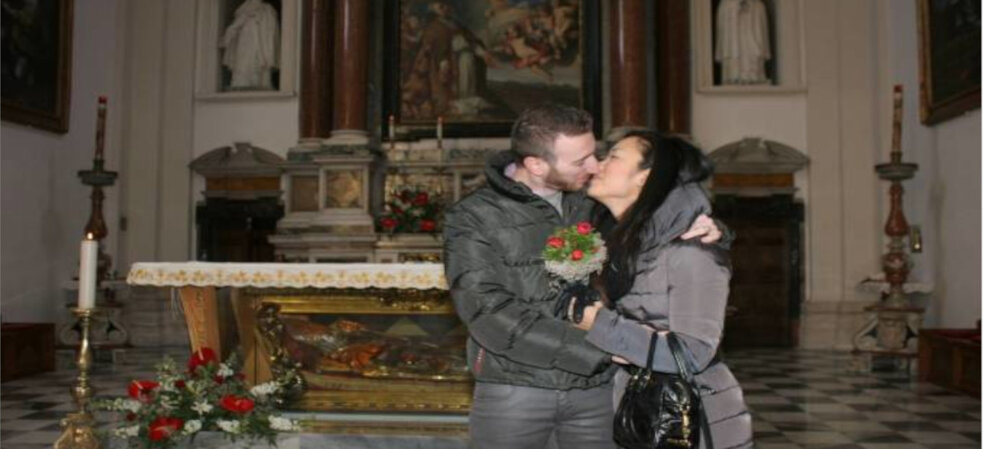
Even today, inside the Basilica of Saint Valentine in Terni, it is possible to visit the Saint's urn, placed at the end of the 1700s beneath the high altar of the Basilica, a place where many pilgrims pray beside the Saint’s remains, Patron of Lovers and Patron of the city.
In Terni Saint Valentine has always been remembered and celebrated for his ancient values, but since 1644, the year the Saint was elected Protector of the city, the citizens have gathered even more closely around him to ask protection for families and the city and to receive comfort for the sick.
The life of Terni blends with this millennia-old popular devotion to Saint Valentine. Professor Pietro Borzomati explains how citizens experience the feast of the city's Patron. «It is the only day of the year in which the City of Terni lives a profoundly different dimension of life: activism, noise, the hurriedness of passers-by give way to a moment of silence, serenity, reflection, which are the antithesis of the usual ways of life and contrast with the fervent work of industry and the demanding commitment of the inhabitants.
The city comes to a halt; in the churches, as for great solemnities, celebrations in honor of the Patron follow one another, while a multitude of people go on pilgrimage to the Basilica to venerate the Saint’s remains and not to miss the Bishop’s Pontifical Mass during which the city administrators pay homage to Saint Valentine who was the first Bishop of Terni».