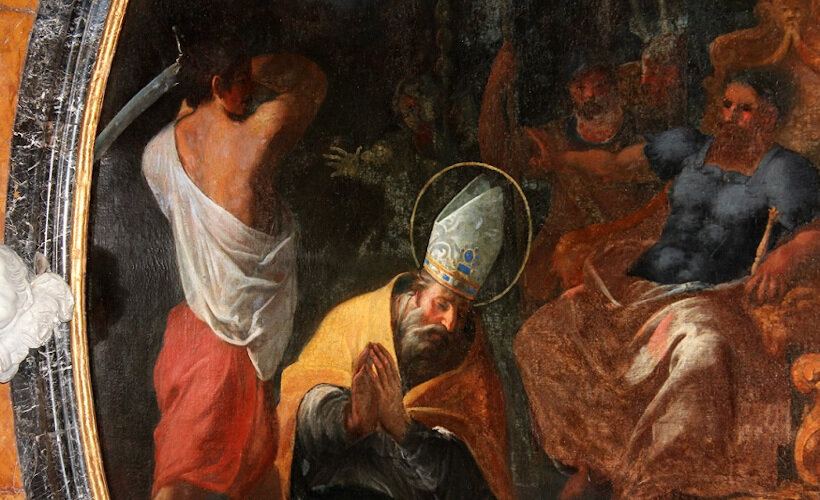

After 313 A.D., with Constantine’s Edict, the faithful of Saint Valentine in Terni increased to the point of giving rise to a liturgical feast on 14 February, the day of his death. Carini Gentile states that the feast of Saint Valentine was already recorded in the centuries prior to the 5th century, a point later confirmed also by Ateneo Antoniano, who maintains that the only feast set by the Gerominian Calendar in the 5th century was that of Terni.
The cult of Saint Valentine soon spread abroad too around the 8th century, a period in which there was a massive expansion of the liturgy thanks to the spread of the Roman calendar throughout Europe. In many European countries there were breviaries that celebrated the memory of the Saint of Terni; there is evidence of passages and summaries of the Passion of the Terni martyr that were read on 14 February.
Another element attesting to the spread of the Valentinian cult is the multiplication of saints named Valentine in many European countries starting from the 10th century. They built basilicas dedicated to them, some of which still today claim the donation of certain relics granted to them in past centuries. The devotion of the faithful was fueled by the fact that Saint Valentine was considered an example of life for the holiness of his existence: he devoted his life to tireless apostolic work, was among the first spreaders of Christianity in Umbria, and brought comfort to the oppressed and the sick.
In England at the beginning of the 8th century local rites were mixed with pagan-Roman rites, giving rise to customs and festivities fused together. In the month of February, besides the feast of Saint Valentine, the Lupercalia were also celebrated, that is, the fertility festival, introduced into the Anglo-Saxon countries by the Romans on the 15th.
According to legend, during the feast, «the names of young men and maidens were drawn who were to celebrate their marriage during the year. As time went by, the habit took hold, on this day, of exchanging gifts and flowers».
Regarding the relationship between the Lupercalia and the celebration of Lovers’ Day, Gianna Vancini believes that the identification between the two festivities may have been determined by the fact that the Pope, seeking to soften the pagan celebration of the Lupercalia, moved this observance from the 15th to 14 February. Consequently, aspects of the pagan feast ended up being linked by the people to Saint Valentine which was celebrated precisely on that day, gradually changing the nature of the pagan fertility festival into a Christian feast.
In this way Saint Valentine would have become, according to the legends, the Protector of Lovers. Among the canonical festivities, the Saturnalia and the Lupercalia were certainly the most awaited by the population. The ceremonies were both a purification rite through the sacrifice of a dog (always a symbol of faithfulness in love) and a feast linked to prosperity and fertility, which is love made tangible.
At the end of the 5th century, when with Pope Gelasius I the Lupercalia were abolished and the feast linked to love moved from the 15th to 14 February, it is inevitable that on the day of Saint Valentine the people attributed part of the ancient rituals of the Lupercalia. The desire to celebrate Saint Valentine as protector of love continued through the centuries without ever experiencing moments of crisis.
In the 19th century the feast began to take on a romantic but also commercial character, as Pompeo De Angelis reports. In the early years of the 1800s the English printing house Dobbs began producing the “Dobbs Patents”, so called after the name of the manufacturer.
They were illustrated postcards used by lovers to exchange love messages. The postcards were so successful that they were featured at the Exhibition in 1851 in London.
In the following years a craftsman named Joseph Mansell began producing love notes decorated with lace and trimmings, but the business of sentimental notes expanded starting from 1860 thanks to perfumers, who prepared sachets with scented essences to sell together with the Dobbs.
The main producer of sachets with scented essences was Eugène Rimmel, who opened shops in London, Paris and New York. In the United States, knowledge and the spread of Saint Valentine came through love notes, promoting 14 February as the date for printing and distributing decorated notes. Thus, Valentine’s Day was created.
The occasion that first brought the notes to the New World was in 1840, when a stationer from Massachusetts named Howland received from an English friend a greeting note with painted flowers and embroidered with lace. Howland’s daughter, Ester, immediately wanted to revive and market the idea, producing decorated love notes with her own hands.
In 1870 Ester Howland founded the New England Valentine, purchasing innovative machinery and incorporating into her company the other small American businesses. Thus the American giant for love notes was born. In 1884 Valentine Writers was published, a book that collected phrases and verses of love poems. The New England Valentine prospered until 1942, the year the company failed.
Valentine’s Day thus changed a millennia-old observance based on the ancient Christian cult.
Numerous are the legends spread around the world that make Saint Valentine the Protector of Lovers. Fedele Santini lists a series of legends concerning Saint Valentine that developed in many countries.
The modern cult of Saint Valentine is widespread in every corner of the world, but the original religious devotion linked to Christianity is also strong and deeply felt by the faithful. A significant testimony of religious devotion to Saint Valentine is the large number of churches, rectories and parish churches dedicated to the Saint that exist in many Italian and foreign locations.
On the web we can note the large number of sites and portals in honor of Saint Valentine, Patron of Lovers, in which anyone can receive and send messages of love, songs, poems and love postcards, creating new friendships and new relationships.