Saint Valentine lived between 175 A.D. and 245 A.D. Finding reliable information about his biography is a hard task, since the historical sources that have reached us are not perfectly trustworthy. For this reason historians are cautious in assessing the material handed down to us. The most credible sources are the Martyrologies, the Passions, the Liturgical Books, the tombs, the churches and the iconography.
The oldest notice about Saint Valentine is found in the Hieronymian Martyrology which was compiled in Italy probably between 460 and 544 A.D. In this precious document, 14 February appears as the date of the death of Saint Valentine of Terni.
The historical value of the Hieronymian is of the first order, both because it is considered a summary collection of information concerning the Saints of the early centuries, and because it has almost never been disproved by archaeological discoveries.
In the book The Cult of Saint Valentine Pompeo De Angelis reports the translation of a further Roman Martyrology, compiled by Cardinal Cesare Baronio and published in 1592.
On the date corresponding to 14 February we find two entries written in Latin and translatable as follows: «In Terni, Saint Valentine, after being beaten for a long time, he was imprisoned and, since his resistance could not be overcome, at midnight at last, secretly dragged out of prison, he was beheaded by order of the prefect of Rome Placido».
In the second we read: «In Rome, on the Flaminian Way, the feast of Saint Valentine Priest and Martyr, who after a holy life in which he showed outstanding doctrine, was killed with clubs and beheaded under Claudius».
Other information reaches us from the Passions which, compared to the Martyrologies, have undergone manipulations over time. However, even from such documents it is possible to gather precious elements for reconstructing the history of the Martyr.
The death suffered by Saint Valentine must have deeply impressed the Church and the faithful, to the point that devotion to him spread at once throughout the Christian world.
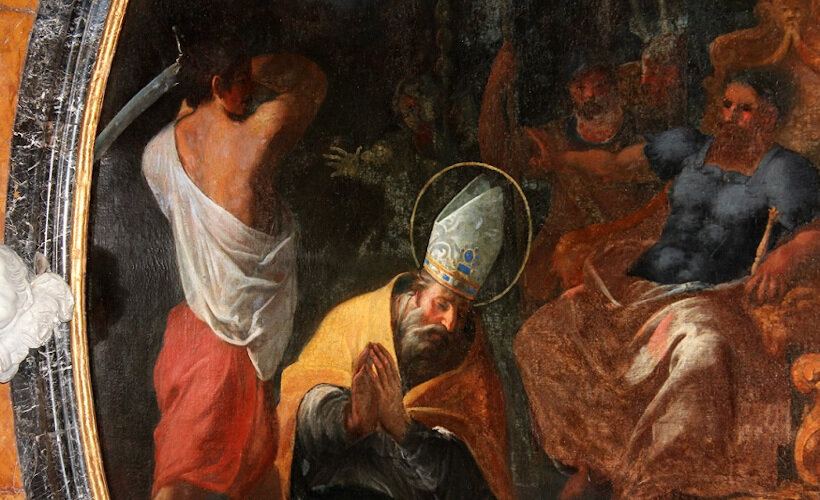
In the figure we find the image of Saint Valentine displayed in the Basilica in Terni dating back to the 16th century. From Angeloni’s account it seems that he belonged to a noble family, devoted himself from a young age to study and to deepening the new religious ideas that soon influenced him, and his ardor led him to dedicate himself to spreading the Christian faith.
In the Passion of Saint Felician, Bishop of Flaminii, we read that Saint Valentine was ordained Bishop of Terni in 197 by Saint Felician himself. Valentine immediately showed his care and devotion toward those in need. But he was not known only for this. His popularity was also due to the fact that he managed to heal incurable sick people by performing countless miracles.
During the Council held in Rome in 250 by Pope Fabian, Valentine restored health to a son of Fonteglio, who presented himself mute and crippled and with his head between his knees.
He devoted himself to serving the poor, comforting widows, caring for orphans, sharing the afflictions of prisoners, and bringing consolation to sinners. He hoped to convert souls to God and to bring happiness to others.
In 1888, at the First Mile of the Flaminian Way, in a cemetery called Saint Valentine, where according to tradition the Saint was temporarily buried, some finds came to light again. Among the many inscriptions recovered in the excavation, Orazio Marucchi studied some fragments belonging to a metrical inscription composed by Pope Damasus in honor of Saint Valentine.
In one of these fragments we read: «Damasus would have addressed a prayer to the martyr so that he might extend his protection, keeping safe both those who were present in his sanctuary and those who from afar commended themselves to him».
It also seems that Valentine «was accused of magic for the healings he performed, and one might therefore suspect that he was a physician», and the same seems to be noted in the Roman Martyrology, where it is said of him that «post multa sanitatum et dotrinae insigna».
Numerous Passionaries recount the ability of Saint Valentine to heal the sick and his desire to spread the new ideas of Christianity among the faithful.
From the Passio Sancti Valentini, compiled in Rome between the 5th and 6th centuries, it is told that Saint Valentine, having become famous for his great charity and humility, was martyred in Rome. A Passionary or Legendary of the Lives of the Saints, dating to the 11th century and once belonging to the Abbey of Saint Anastasius in Rome, without historical claims, reports the last miracle performed by the Saint, because of which he was martyred.
Beyond the historical value of the information that has reached us, we must consider how much the faithful revered Saint Valentine and how they preferred to remember him as a figure faithful to the ideals of Christianity, for which he strove throughout his whole life, even choosing death rather than betraying his faith.
Valentine’s followers, Proculus, Efebo and Apollonius, after the martyrdom, probably carried the Holy Body along the Flaminian Way. Arriving near the city of Interamna (today’s City of Terni) about LXIII miles from the city of Rome, they gave the Saint a worthy burial in the presence of some relatives and fellow citizens of Christian faith.
Some accounts report that the death sentence by beheading was carried out in Rome during the night to avoid riots and reprisals by the people of Terni, who so loved and venerated their Bishop and illustrious citizen. At the place of his burial the faithful built an oratory and near the Saint’s tomb the requests of the faithful and of other martyrs to be buried there multiplied.
From this complex documentation the figure of Saint Valentine emerges as an example of life and as a promoter of the values of Christianity during the period of decline of the Roman Empire.
From the accounts of the Passionaries one notes a mixture of historical data and legendary data; for this reason it is difficult to derive a complete picture of all the information concerning Saint Valentine. Today, however, «it is held that the legend itself is a fact, in the sense that it documents a mentality» and a feeling of those who wished to remember the Saint in his most authentic values.
Angeloni thus praises this figure: «Glory therefore, City of Terni, to have in Heaven such a Saint, your fellow citizen and Protector; and with faith have recourse to his pious intercession in your needs; for he, to answer his piety, will abundantly console you».